


🎀Tai Chi Chair Workout Chart for Seniors (16 x 24 inches)
🎀Tai Chi Chair Workout Chart for Seniors (16 x 24 inches)


No se pudo cargar la disponibilidad para recogerlo
-
Pedido
- - -
Pedido listo
- - -
Entregado

🎀Tai Chi Chair Workout Chart for Seniors (16 x 24 inches)
16 Illustrated Seated Tai Chi Movements. Clear Instructions. 16 × 24 Inches. Balance, Flexibility & Mindful Daily Movement — From the Comfort of a Chair.
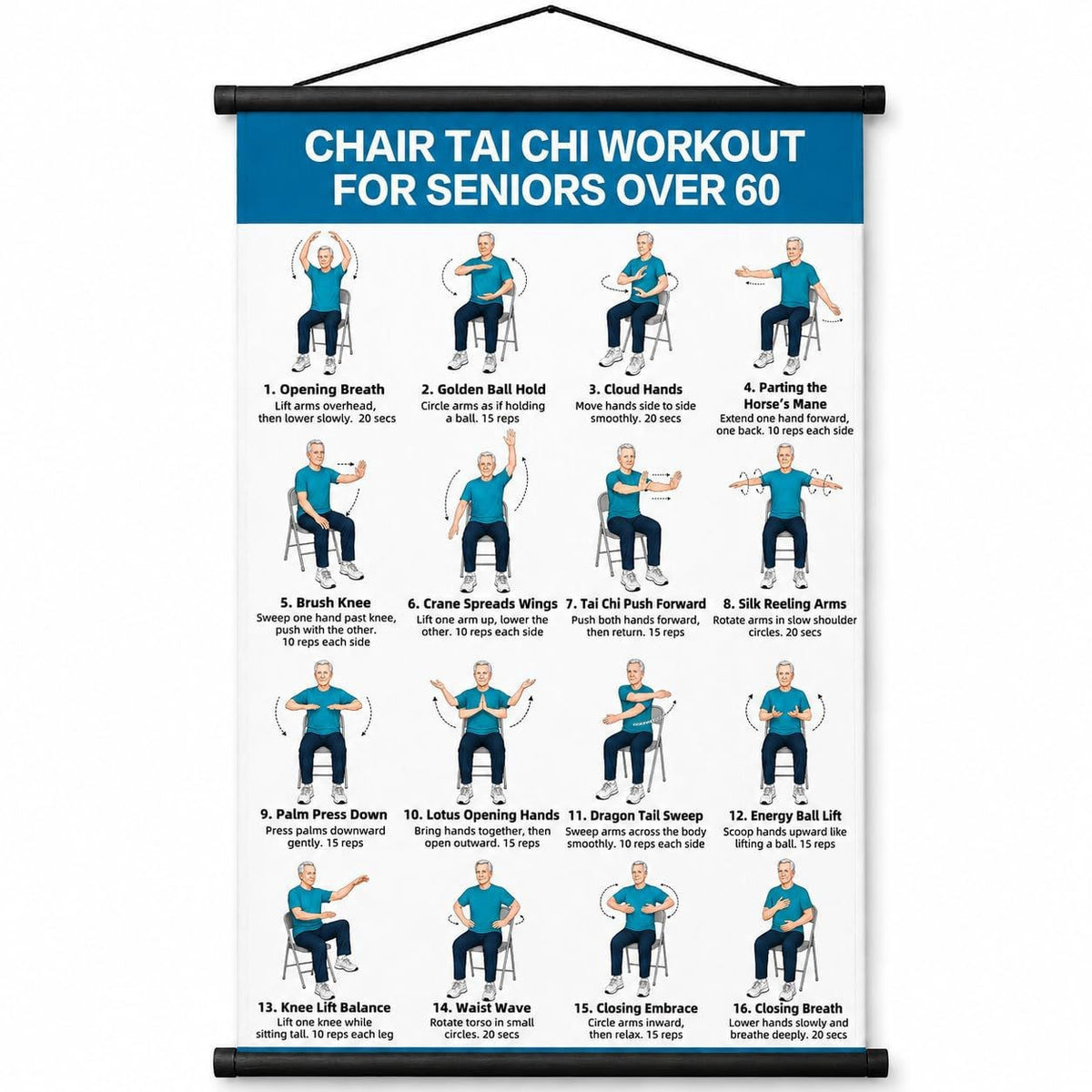
Introducing the Tai Chi Chair Workout Chart for Seniors — a 16 × 24-inch wall chart presenting a complete 16-move seated Tai Chi routine with clear illustrations, exercise names, and short step-by-step instructions for each movement. Designed specifically for seniors over 60, beginners, and those who prefer low-impact seated exercise, the chart covers the full range of a balanced Tai Chi practice: breathing and warm-up, upper-body arm and shoulder movements, gentle lower-body leg exercises, side and neck stretches, and a mindful cool-down sequence. Display it on any wall, follow the numbered sequence from a standard chair, and build a consistent daily movement habit without video subscriptions, class schedules, or complicated equipment.
🧘 16 Illustrated Moves · 🪑 Fully Seated Routine · ✅ Beginner-Friendly · 📊 16 × 24 In Easy-View Size · 🏠 Home & Senior Center Use

🪑 Four Daily Benefits. One Simple Seated Routine.

📋 16 Illustrated Exercises. Upper Body, Lower Body, Stretching & Cool-Down. Complete in One Chart.

👁️ Beginner-Friendly Layout. See It. Read It. Do It. No Teacher Required.

🏠 Four Settings. One Chart That Works in All of Them.
🧘 5 Steps. Display. Sit. Follow the Sequence. Breathe. Build the Habit.

- Hang the Chart at Eye Level — Display the chart on a wall in the room where exercise will happen — at a height where the illustrations and instructions are clearly readable from a seated position in the chair you plan to use. The top and bottom hanging rods make wall display straightforward — use a standard picture hook or adhesive hook at the appropriate height. For optimal readability, the center of the chart should be approximately at eye level when seated.
- Choose a Stable Chair — Select a firm, stable chair without wheels — a standard dining chair or sturdy armchair without castors. The chair should allow both feet to rest flat on the floor with hips at approximately 90 degrees. Avoid soft chairs or chairs with very deep seats that tip the pelvis backward — an upright seated position allows the full range of spinal rotation and arm movement the routine requires. Place the chair where the chart is visible without turning the head significantly.
- Follow the Numbered Sequence — Begin with Exercise 1 and proceed through the sequence in numbered order. Each exercise is illustrated with a figure showing the body position and directional arrows indicating the movement. Below each illustration, a short written instruction and suggested repetitions or hold time provide all the guidance needed. Do not rush — Tai Chi is defined by slow, deliberate movement. If a movement feels unclear, stay with the illustration until the direction of motion is understood before beginning.
- Breathe Deliberately Throughout — Tai Chi is a breath-led practice — the movements are designed to coordinate with the breath rather than to be performed independently of it. As a general principle: breathe in as the body opens or rises, breathe out as the body closes or settles. The breathing exercises at the start of the sequence establish the rhythm — carry that rhythm through the arm, leg, and stretching movements. If the breath becomes labored, slow down further — the pace of the movement should always allow comfortable, unhurried breathing.
- Practice Daily for Best Results — A single session of 10–20 minutes is sufficient for the full 16-move sequence at a comfortable pace. The benefits of Tai Chi are cumulative and closely tied to regularity — a daily practice of even 10 minutes produces more consistent benefit than an occasional hour-long session. The wall chart’s visible presence in the room serves as a daily environmental cue — making the decision to practice easier by reducing the friction of remembering, finding, and starting the routine.
— Go through the chart once slowly without moving — look at each illustration and read the instruction before beginning the physical practice — familiarity with the sequence dramatically reduces hesitation during the first session.
— Start with 5–8 movements — if the full 16-move sequence feels like too much initially, start with the first half and add more movements as comfort and confidence build.
— Never push into discomfort — Tai Chi movements should feel gentle and releasing rather than effortful — reduce the range of any movement that causes discomfort and stop if any pain occurs.
— Morning is the traditional Tai Chi time — practicing after waking and before the day’s demands accumulate takes advantage of the natural calm of the morning and sets a positive tone for the day.
Product Details
| Feature | Detail |
|---|---|
| Product | Tai Chi Chair Workout Chart for Seniors |
| Display Size | 16 × 24 inches (vertical format) |
| Exercises | 16 illustrated seated Tai Chi movements |
| Content | Illustrations · exercise names · short instructions · repetition guidance |
| Movement Types | Breathing · upper body (arms, shoulders, wrists) · lower body (knees, legs, ankles) · stretching · cool-down |
| Recommended For | Seniors 60+ · beginners · caregivers · senior wellness programs |
| Display | Vertical wall chart with top and bottom hanging rods |
| Best Used In | Home · bedroom · living room · senior center · activity room · caregiver spaces |
| Difficulty | Beginner-friendly · no prior Tai Chi experience required |
| Equipment Required | Standard stable chair only |
Common Questions, Answered
Is this suitable for someone with no Tai Chi experience?
Yes — the chart is specifically designed for seniors and beginners with no prior Tai Chi experience. Each exercise is illustrated and accompanied by a short written instruction so the routine can be followed independently from the first session. No background knowledge of Tai Chi terminology or philosophy is required to use the chart effectively. The numbered sequence removes any uncertainty about what to do next, and the movements themselves are simple enough to begin after a single read-through of the chart.
Are all 16 movements performed while seated?
Yes — the entire routine is designed around seated chair movements. No floor transitions, kneeling, or extended standing is required. The chair provides full support throughout every movement in the sequence, making the routine genuinely accessible for seniors with balance concerns, joint limitations, post-surgery recovery needs, or simply a preference for seated exercise over standing routines.
How long does the full routine take?
At a typical Tai Chi pace — slow, deliberate, and unhurried — the full 16-move sequence takes approximately 10–20 minutes depending on the number of repetitions per movement and the pace chosen. Beginners often take longer initially as they reference each illustration and instruction. As the sequence becomes familiar, many seniors find a natural rhythm of 12–15 minutes for the complete routine. There is no required duration — the routine can be shortened by reducing repetitions or lengthened by adding extra repetitions to movements that feel particularly beneficial.
Can this be used in a senior center or group exercise setting?
Yes — the 16 × 24-inch format is designed to be visible from a reasonable distance when mounted on a wall, making it suitable for small group settings where multiple participants can follow the chart simultaneously. For larger groups or rooms, two charts mounted side by side are recommended. The numbered sequence makes it easy for a facilitator or caregiver to call out the exercise number and have participants locate it quickly without confusion.
Does this replace advice from a doctor or physiotherapist?
No. The chart is a general visual exercise guide designed for healthy seniors who want to incorporate gentle daily movement into their routine. It is not a medical or therapeutic prescription. Seniors with health conditions, injuries, recent surgeries, significant balance concerns, or movement limitations should consult an appropriate healthcare professional — a doctor, physiotherapist, or occupational therapist — before beginning any new exercise routine. Always practice at a comfortable pace and stop if any pain or discomfort occurs.
Simple. Clear. A Daily Practice That Actually Sticks.
“I bought this for my mother who is 78 and has been reluctant to exercise because everything she found required standing or getting on the floor. She has been doing the full routine every morning for three weeks now. The chart is clear enough that she can follow it independently without any help from me. She says it takes her about 15 minutes and she feels ‘looser’ in her shoulders and hips afterward. The fact that it’s on the wall and she sees it every day is what makes her actually do it.”
“I run a small activity program at a senior living community and I’ve been using this chart in our weekly movement sessions. The illustrations are clear enough that participants can follow along without me narrating every movement, which lets me walk around and assist those who need individual guidance. The size is good for a small group — everyone can see it from a seated position. I’ve ordered two more for different rooms. Well-designed and genuinely useful.”
“I’m 71 and bought this for myself after my physiotherapist recommended gentle daily movement for hip stiffness. I had tried YouTube videos but never managed to make them a habit — I’d forget to open the app or get distracted. Having the chart on the wall next to my morning chair means I see it immediately and just… start. I do the full sequence every morning now and my hip mobility has noticeably improved over six weeks. The breathing movements at the start are the part I enjoy most.”
Shop with Confidence
Questions? Contact us anytime — we’re here to help.
For general wellness use only · Consult a healthcare professional before beginning any new exercise program · Stop immediately if pain or discomfort occurs.


También te puede gustar
-
Spray abrillantador de madera con cera de abejas – Restaura y da brillo
Precio regular $24.99Precio regular $24.99 Precio de ofertaPrecio unitario por$48.9948% -
Ganchos mariposa giratorios autoadhesivos
Precio regular Desde $13.99Precio regular Desde $13.99 Precio de ofertaPrecio unitario por -
Foldable Pet Grooming Bath Stand for Small & Medium Dogs
Precio regular Desde $59.98Precio regular Desde $59.98 Precio de ofertaPrecio unitario por -
Limpiador magnético de ventanas, limpiavidrios de doble cara con imán ajustable, cepillo y herramientas de lavado
Precio regular $25.99Precio regular $25.99 Precio de ofertaPrecio unitario por


